
2-color pyrometers
2-color pyrometers measure the infrared radiation at two closely spaced wavelengths at the same time and determine the temperature by forming a quotient.
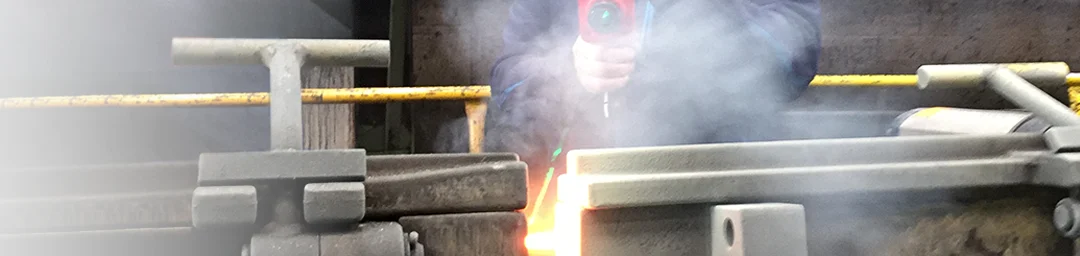
Such devices are often used for measurements through dirty windows, steam or dust in the pyrometer's field of view. Even if the measuring object is smaller than the pyrometer measuring field or the emissivity of the material is unknown or an exact determination is not possible.
Our 2-color pyrometers are characterized by:
- 2 separate measuring detectors for the two spectral ranges for reliable recording of measured values even with low signal strengths.
- Digital microcontroller signal processing for 100% reproducibility of the displayed measured values.
- IR signal monitoring for warning if the optics or windows are too dirty.
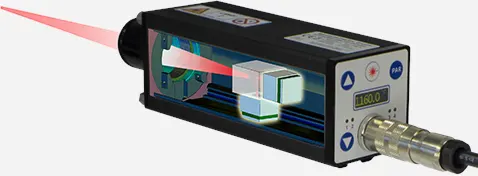
The ratio technique also allows the determination of very special applications such as pouring stream measurement or the flame measurement. Intelligent algorithms are also integrated here, which output a reasonable measurement result from the complex interaction of the individual signals, the signal strengths and the different emissivity of the measurement wavelengths.
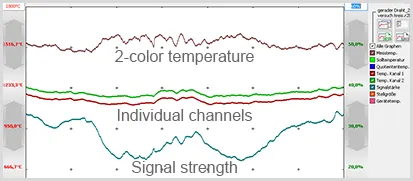
Always included: Software SensorTools
for displaying and evaluating the
- 2-color temperature
- Temperatures of the individual measurement spectral ranges
- Signal strength
2-color pyrometers are available in the following series:
-
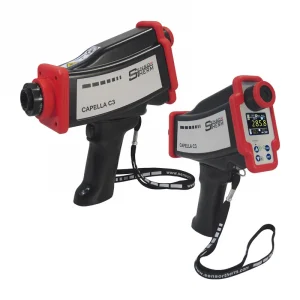
CAPELLA C311 (Portable 2-Color Pyrometer)
3 temp. ranges betw. 600 and 2500°C / 1112 and 4532°F;
Spectral range 0.75–1.1 µm; <1 ms fast;
Smallest spot size 1.2 mm; 0.4 mm with close-up lens
Display, adjustment keys, USB -
CAPELLA C322 (Portable 2-Color Pyrometer)
3 temp. ranges betw. 300 and 1800°C / 572 and 3272°F
Spectral range 1.45 – 1.8 µm; <1 ms fast;
Smallest spot size 1.2 mm; 0.4 mm with close-up lens
Display, adjustment keys, USB -
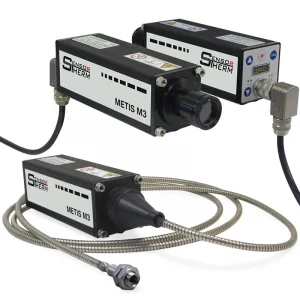
METIS M322 (2-Color Pyrometer)
7 temp. ranges between 300 and 3300°C / 572 and 5972°F
Spectral range 1.45 – 1.8 µm; <1 ms fast;
Smallest spot size 0.8 mm
Display, adjustm. buttons, switching inputs / outputs -
METIS M311 (2-Color Pyrometer)
7 temp. ranges betw. 600 and 3300°C / 1112 and 5972°F
Spectral range 0.75 – 1.1 µm; <1 ms fast;
Smallest spot size 0.8 mm
Display, adjustm. buttons, switching inputs / outputs -
METIS M3F1 (Flame Pyrometer)
4 temp. ranges between 600 and 3300°C / 1112 and 5972°F
Spectral range 0.695 – 1.1 µ m; 10 ms fast
Display, adjustm. buttons, switching inputs / outputs -
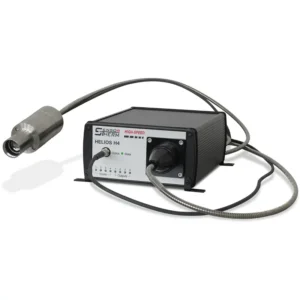
HELIOS H422 (High-Speed 2-Color Pyrometer)
Temp. range 700 – 2300°C / 1292 – 4172°F
Spectral range 1.45 – 1.8 µm; < 50 µs fast
Smallest spot size 0.8 mm
Ethernet, switching inputs/outputs -
HELIOS H433 (High-Speed 2-Color Pyrometer)
Temp. range 700 – 2300°C / 1292 – 4172°F
Spectral range 1.6 – 2.1 µm; < 50 µs fast
Smallest spot size 0.8 mm
Ethernet, switching inputs/outputs -
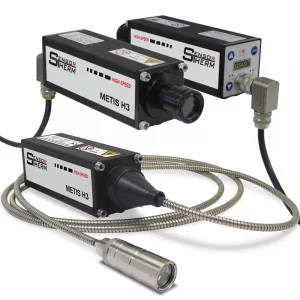
METIS H322 (High-Speed 2-Color Pyrometer)
8 temp. ranges betw. 350 and 3000°C / 662 and 5432°F
Spectral range 1.45 – 1.8 µm; < 80 µs fast;
Smallest spot size 0.8 mm
Display, adjustm. buttons, switching inputs / outputs -
METIS H311 (High-Speed 2-Color Pyrometer)
7 temp. ranges betw. 600 and 3300°C / 1112 and 5972°F
Spectral range 0.75 – 1.1 µm; < 80 µs fast;
Smallest spot size 0.8 mm
Display, adjustm. buttons, switching inputs / outputs -
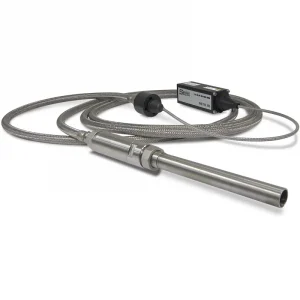
Heavy-Duty Measuring System for METIS M3 or H3 Pyrometers
Focus distance up to 4.5 m
Use up to 250°C on the measuring head
Stainless steel braided hose in lengths up to 30 m
Air purge for the optics system
What role does the distance between the two wavelengths play?
An independent measurement is carried out in each wavelength range, which normally requires the emissivity of the measuring material. However, since this is cut out again when the relationship is formed, it is on the other hand not necessary to know it.
Voraussetzung für ein fehlerfreies Messergebnis ist allerdings ein immer konstantes Verhältnis, auch wenn die Messtemperatur sich ändert. Bei vielen Materialien ändert sich der Emissionsgrad aber abhängig von der Temperatur oder auch dem Messwinkel. Je weiter die beiden Messwellenlängen nun auseinander liegen, umso stärker ändert sich bei solchen Materialien das Verhältnis, wenn sich die Temperatur ändert. Die Messabweichungen sind dann unterschiedlich groß, je nachdem, welche Temperatur gerade gemessen wird. Messgeräte mit weiter auseinanderliegenden Spektralbereichen sind nur für Messungen an sogenannten "grauen Strahlern" geignet, die es in der Regel nicht gibt.
The measuring wavelengths of Sensortherm's 2-color pyrometers are close to each other in order to keep this error as low as possible. The individual measurement results of the two spectral ranges are therefore more parallel, which is necessary in order to always correctly calculate the quotient at all measurement temperatures.
When do I have to adjust the emissivity slope?
Measuring objects that emit the same on the two wavelengths of a 2-color pyrometer are often referred to as "Gray bodies" (e.g. well oxidized iron or steel surfaces). They can be measured accurately with the setting 1.00 for the emissivity slope without correction. Measuring objects whose emissivity is different on the two wavelengths of the pyrometer (e.g. shiny un-oxidized metal surfaces) need for accurate temperature measurement a correction setting, the so-called emissivity slope Ɛ2/ Ɛ1. The value can be larger or less than 1, depending on whether the emissivity of channel 1 or 2 is higher (0.800–1.000: gain, temperature display will be higher; 1.000–1.200: Attenuation, temperature display will be lower).
Regardless of emissivity slope 1 or above or below is used to measure, the ratio must remain constant in the required temperature range. In the SensorTools softeware, the 2-color temperature and those of the two channels can be displayed at the same time. A 2-color measurement is possible if the curves of the two channels in the required measuring range run uniformly parallel, so the ratio is constant. If the temperature values of the curves are identical (at the same emissivity setting), then the emissivity slope is 1. Do they run parallel, so the correct value for the emissivity ratio must be found, such by comparative measure-ment with a thermocouple and subsequent ratio setting until the temperatures match.
In der Software „SensorTools“ können die Quotienten-Temperatur sowie die Temperaturen der beiden Einzelkanäle gleichzeitig angezeigt werden. Eine Quotientenmessung ist dann möglich, wenn die Kurven beider Kanäle im gewünschten Messbereich gleichmäßig parallel verlaufen, was bedeutet, dass das Verhältnis konstant ist. Sind die Temperaturwerte der Kurven identisch (bei gleicher Emissionsgradeinstellung), so beträgt das Emissionsgradverhältnis 1. Verlaufen die Kurven parallel, muss der korrekte Wert für das Emissionsgradverhältnis ermittelt werden – beispielsweise durch eine Vergleichsmessung mit einem Thermoelement, bei der das Verhältnis so lange angepasst wird, bis die Temperaturwerte übereinstimmen.